Two minutes for ten questions
AI will not decide whether your child learns. The habits you build at home will. Let me start with a scene many parents will recognise.
It is 9 pm. Your child sits at the dining table with a maths worksheet: ten questions on quadratic equations. Two minutes later, the worksheet is done. Every answer is correct, every step neatly written. You are impressed for a moment. Then you see the phone lying next to the notebook, an AI app still open on the screen.
You feel two things at once. Relief, because homework is finished and there is no fight tonight. And a quiet worry: did my child actually learn anything?
That worry is the right instinct. This article is about what to do with it.
AI is now inside the school and inside the phone
AI is no longer a future topic. It is already in your child’s syllabus and in their pocket.
From the 2026–27 session, CBSE has brought in a curriculum on Computational Thinking and Artificial Intelligence (CT & AI) for Classes 3 to 8, launched through Circular Acad-15/2026 in April 2026. The board says its aim is to develop “AI-ready learners” by building computational thinking first. For the youngest classes, the first stated goal is basic problem-solving for daily-life problems (Class 3 Teacher Handbook).
Notice what the board put first: thinking, not tools. Even the people writing the AI syllabus agree that a child must learn to break a problem into steps before a machine can be useful to them.
Meanwhile, at home, free AI apps can solve a Class 12 integral, write an English essay or explain a physics derivation in seconds. The school teaches AI for a few periods a week. The phone offers it every minute of the day. That gap is where you come in.
A gym where the machine lifts the weights
AI can hand your child an answer. It cannot hand them understanding. That only grows when the child does the struggling.
Think of a gym. If a machine lifted the weights for you every day, the logbook would look excellent and your muscles would not change at all. Homework works the same way. The point of solving ten quadratics is not the ten answers. It is the small moments of getting stuck, trying something, being wrong and fixing it. That is the workout.
Used well, AI can be a very good coach in that gym:
- Explaining a concept again, in simpler words, as many times as the child needs, without impatience.
- Giving a hint instead of a full solution, when the child is truly stuck.
- Checking work after the child has finished, and pointing out where a step went wrong.
- Making extra practice, such as five more questions like the one the child found hard.
Used badly, it does the workout for them:
- Copying full solutions into the notebook.
- Writing essays and projects the child then submits as their own.
- Answering every doubt before the child has spent even five minutes thinking.
There is one more catch. AI tools sound confident even when they are wrong. In maths it is common to find an AI solution with a sign error in line three and a perfectly formatted wrong answer at the end. A child who cannot check the work cannot tell the difference. And the board exam hall, or the JEE centre, has no AI in it.
Your role: five jobs only you can do
You do not need to understand how AI works to guide your child well. You need to do five ordinary parenting jobs, applied to a new tool.
- Be the curious one, not the police. Ask your child to show you the app they use and how they use it. Children hide what they are scolded for and share what you show interest in. A ten-minute demo at the dinner table tells you more than any rule.
- Ask “explain it to me”. This is the simplest test there is. After homework, pick one question and ask your child to explain it to you in their own words, without the notebook. If they can, the learning happened, whatever tool they used. If they cannot, the AI did the workout.
- Protect the struggle. Make a family rule: try for at least 10–15 minutes before asking AI, and ask for a hint, not the answer. Being stuck is not a problem to remove. It is where learning happens.
- Set the place and the time. Homework at a shared table, not behind a closed door. Phones in another room during self-study, and brought back only when needed for checking. Structure does more than willpower, for children and for adults.
- Model honest use yourself. If you use AI at work to draft an email, say so, and say that you checked it before sending. Children copy what we do far more than what we say. Talk openly about why submitting AI-written work as your own is dishonest, not just risky.
None of these needs technical knowledge. All of them need your presence.
A one-page family AI agreement
Sit with your child this week and agree on a few rules together. Rules a child helped write are rules a child keeps. Here is a starting list; change it to suit your home.
- ☐ I will try every question on my own for at least 10 minutes before asking AI.
- ☐ When I ask AI, I will ask for a hint or an explanation first, not the full answer.
- ☐ I will never submit AI-written work as my own.
- ☐ I will check AI’s answers, because AI can be wrong.
- ☐ I can explain any homework answer in my own words if asked.
- ☐ During self-study, my phone stays outside the study room unless I need it to check work.
- ☐ If I am confused or stuck for long, I will tell my parent or teacher, not just the app.
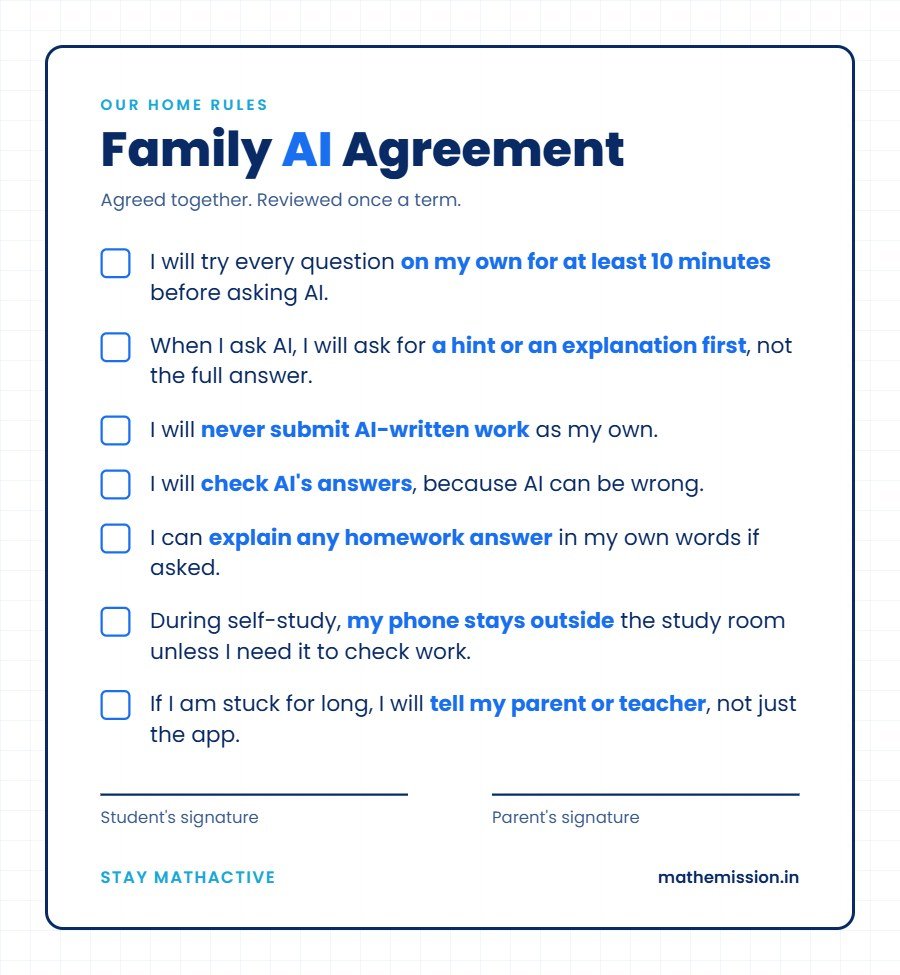
Print it, both of you sign it, and stick it near the study table. Review it once a term, as your child grows older and the tools change.
How to tell if it is going well
You can tell how your child uses AI without reading their chat history. Watch what happens in class tests and in conversation.
| What you notice | Healthy use | Worrying use |
|---|---|---|
| Homework vs class tests | Marks are similar in both | Homework is perfect, test marks keep falling |
| Explaining an answer | Explains in their own words, even if slowly | “The app said so” or cannot explain at all |
| When stuck | Tries first, then asks for a hint | Opens the app before reading the question fully |
| Written work | Sounds like your child, mistakes included | Sounds like a textbook, with words they don’t use |
| Time on homework | Takes a reasonable time, some days longer | Finishes everything in minutes, every day |
| Talking about AI | Tells you when AI was wrong or unhelpful | Gets defensive or hides the screen |
One warning sign is not a crisis. A pattern across weeks is worth a calm talk, and a word with the subject teacher.
A note from a maths teacher
After many years of teaching Class 11–12 and JEE students, I’m sure of one thing: the students who do well are not the ones who see the most solutions. They are the ones who have thought about the most problems.
That has always been true, long before AI. When we had solution manuals at the back of the book, the same choice existed: look at the answer, or sit with the question a little longer. AI has made that choice faster and more tempting. It has not changed which choice builds a mind.
So here is my request to every parent reading this. Don’t fear AI, and don’t ban it. Your child will work alongside these tools all their life, and the new CBSE curriculum is right to teach them early. But stay in the room, ask your child to explain, and protect the struggle. The machine can give the answer. Only your child can grow the understanding, and only you can make the space for it at home.
Stay Mathactive.
— Ashutosh Kumar
Sources
- CBSE, Circular Acad-15/2026: CT & AI Curriculum for Classes III–VIII (2026–27)
- CBSE, Computational Thinking, Class 3 Teacher Handbook (March 2026)
- PIB, Launch of the CBSE CT & AI curriculum, 1 April 2026
Get Mathactive Sunday in your inbox
A new article every Sunday morning on mathematics, learning and teaching, for parents and teachers. Free, and you can unsubscribe at any time.
Prefer videos, or a short post every day?