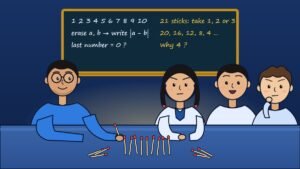
Walk into almost any classroom a week before an examination and observe carefully.
Students are solving question banks. Teachers are predicting important questions. Parents are asking about expected marks. Coaching centers are distributing “sure-shot” worksheets. Everyone appears intensely occupied with mathematics.
But are they? Perhaps something else is happening. Perhaps we are not teaching mathematics at all.
Perhaps we are teaching studenting.
What Is Studenting?
Studenting is the art of surviving the educational system. It is the ability to recognize patterns in examinations, memorize procedures, identify shortcuts, and maximize marks while minimizing intellectual effort. It is a highly developed skill, and many students become remarkably good at it.
A successful student knows which chapters are important, which formulas are likely to appear, which steps earn marks, and which mistakes lose them. They learn how to perform successfully within the rules of the game. None of this is inherently bad.
When Success Hides the Problem
The problem begins when studenting becomes indistinguishable from learning.
A student may score ninety-five percent in mathematics and yet remain unable to think mathematically. They can differentiate complicated functions but cannot explain what a derivative means. They can reproduce proofs but cannot discover one. They can solve familiar problems but freeze when confronted with an unfamiliar question.
The tragedy is not that they fail.
The tragedy is that they succeed.
Their success convinces everyone—including themselves—that learning has occurred.
Real Mathematics Begins with Uncertainty
Yet genuine learning looks very different. Real mathematics begins with uncertainty. It begins when a student encounters a problem for which no immediate method is available. It begins when confusion is tolerated rather than avoided. It begins when the mind struggles, explores, fails, and reorganizes itself.
Unfortunately, struggle has become unpopular. Modern students often experience difficulty as a sign of inadequacy rather than a necessary stage of understanding. The moment thinking becomes uncomfortable, many look for a shortcut, a trick, a formula sheet, a video solution, or increasingly, an AI-generated answer.
The goal quietly shifts from understanding the problem to eliminating the discomfort.
But cognitive effort is not the enemy of learning.
It is the mechanism of learning.
Cognitive psychologists have been telling us this for a long time. Roediger and Pyc (2012) point out that what is repeated back to back is learned quickly but fades fast, while what is practised with effort, spaced over time, is learned more slowly and retained far longer. What feels slower is often what lasts.
A muscle grows by resisting weight. A mind grows by resisting confusion. When we remove every obstacle, we do not make learning easier. We make it shallower.
The Teacher’s Trap
Yet teachers themselves are trapped. Parents demand results. Schools demand rankings. Boards demand performance metrics. Universities demand scores.
In such a system, teaching students to think can appear irresponsible. Thinking takes time. Examinations do not. A teacher who spends twenty minutes discussing why a theorem is true may be viewed as inefficient. Another teacher who provides a memorization trick may be praised for being practical.
The incentives are clear.
Understanding is expensive.
Marks are efficient.
And so classrooms gradually transform.
Questions become templates.
Methods become recipes.
Proofs become rituals.
Mathematics becomes a sequence of procedures to be executed rather than ideas to be explored.
The subject survives. The spirit disappears.
What Remains After We Forget
Years later the consequences become visible. Students forget formulas. They forget identities. They forget methods they once performed flawlessly.
We often interpret this forgetting as evidence that education has failed. But forgetting facts is natural. The more important question is: What remains?
- Does the student retain intellectual curiosity?
- Can they reason through a new problem?
- Can they tolerate uncertainty?
- Can they recognize structure beneath surface details?
- Can they think?
If the answer is yes, then education has succeeded even if many details have been forgotten. If the answer is no, then high scores become little more than historical records of temporary performance.
The purpose of mathematics was never merely to produce correct answers. Mathematics teaches patience. Precision. Logical consistency. The willingness to follow an idea wherever it leads. It teaches us that intuition can be wrong and that truth must sometimes be earned through effort.
These lessons matter long after specific formulas have vanished from memory.
Credentials and Competence
Perhaps the greatest responsibility of a mathematics teacher is not to prepare students for the next examination. It is to prepare them for a lifetime of thinking.
This does not mean abandoning examinations or ignoring marks. Students need both credentials and competence. The challenge is to remember that the two are not the same.
A mark sheet can measure performance. It cannot measure wonder.
It can reward memory. It cannot reward curiosity.
It can count answers. It cannot count understanding.
The danger arises when we mistake what is measurable for what is valuable.
So perhaps the question every mathematics teacher should occasionally ask is not: “Are my students solving enough problems?” But rather:
“Are my students becoming thinkers?”
Because if we are not careful, we may produce generations of excellent students who know how to study, how to score, and how to succeed in examinations—yet never discover what it means to learn.
And then, despite all our mathematics classes, we will not have taught mathematics at all.
We will have taught studenting.
Stay Mathactive.
— Ashutosh Kumar
Sources
- Roediger, H. L., & Pyc, M. A. (2012). Inexpensive techniques to improve education: Applying cognitive psychology to enhance educational practice. Journal of Applied Research in Memory and Cognition, 1(4), 242–248.
Get Mathactive Sunday in your inbox
A new article every Sunday morning on mathematics, learning and teaching, for parents and teachers. Free, and you can unsubscribe at any time.
Prefer videos, or a short post every day?