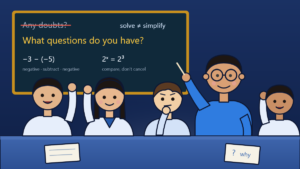
A few years ago I wrote a short note in my journal. It was not about mathematics at all. It was about the ordinary problems of a day, the ones that arrive uninvited and refuse to leave. I wrote: “Gamify the problems of life. Do not make them tough. Let them be easy as they were at the time of their occurrence.”
I did not know then that I was writing about my classroom.
Every teacher knows the face a student makes when a new problem appears on the board. The shoulders drop. The pen stops. The eyes go to the clock, to a friend, or to the back of the book. It is not the face of someone who cannot do mathematics. It is the face of someone who has already decided that the problem is heavy.
Why a Problem Feels Heavy
Most problems are not heavy when they are born. A question about numbers on a board, about a shape, or about a pattern is light. It becomes heavy on its way to the student. We attach labels to it: “important for boards”, “asked in JEE 2019”, “Chapter 7, Exercise 4”. We attach consequences to it: marks, ranks, the look on a parent’s face. By the time the problem reaches the student, it is carrying all of that weight.
My old note put it better than I can now: “Your thought, your labels, your ego, your overthinking, your reactions are making a problem unsolvable. Otherwise, it is readily solved.”
A game strips that weight away. Nobody fears a game. In a game, losing a round is part of playing, and trying a silly move costs nothing. That is exactly the attitude a good problem solver needs, and exactly the attitude our examination system slowly trains out of our students.
Two Games on the Board
Let me show what I mean with two problems I would love to bring into a classroom.
The first is a game with matchsticks. Put 21 matchsticks on the table. Two players take turns. On each turn, a player removes one, two or three sticks. Whoever takes the last stick wins.
Imagine not announcing it as a problem at all. The teacher simply asks, “Who wants to play against me?” A hand goes up, then another. The teacher, who knows the secret, wins the first game, and the second. By the fourth game, the class would no longer be watching the matchsticks. They would be watching the teacher. Sooner or later someone notices that after each of the teacher’s turns, the sticks left are always 20, 16, 12, 8 and then 4. Someone else asks, “Why four?” And now, without a single formula on the board, the class is talking about remainders on division by 4. This is Bachet’s game, one of the classics in the chapter on games in Arthur Engel’s Problem-Solving Strategies.
The second looks like a puzzle. Write the numbers 1 to 10 on the board. Choose any two, erase them, and write their difference in their place. Keep going until only one number is left. Can that last number be 0?
Students would start erasing at once. Some would end with 1, some with 3, some with 7. Nobody would get 0. After a few minutes of play, the question changes by itself, from “What is the answer?” to “Why can we never get 0?” That is the moment worth waiting for. The answer lives in something that does not change. The sum of the numbers starts at 55, an odd number, and every move changes the sum by an even amount. So the sum stays odd, and the last number must be odd too. Engel opens his book with exactly this idea, the invariance principle, and states it in one line: “If you have a transformation, look for an invariant!”
Neither problem is easy. But both can be played, not suffered.
Four Verbs for the Classroom
My journal note ended with four short lines. Read again as a teacher, each one turns into a piece of classroom advice.
Gamify the problems of the day. Give the problem the shape of a game: clear rules, a goal, and a move that can be made right now. A student who can make a move is no longer stuck; they are playing. Even a routine exercise can be offered this way: “Here is a function. Your move: find one value of x where it becomes zero.”
Modify the circumstances. If the game is too big, change it. Play with 5 matchsticks before 21. Try the numbers 1 to 4 before 1 to 10. Students may be surprised that they are allowed to do this. Changing the numbers is not cheating; it is how mathematicians explore.
Simplify the very moment. Take away what is not needed in this minute: the chapter name, the marks, the year it was asked. What is left is a question that someone can think about calmly.
Identify the true player. In a game, the player is the one who moves. If the teacher makes every move on the board, the student is only a spectator. Our job is to be a good referee: set the rules, keep the game fair, and step back.
Take a problem as a game, and you are the key player of it.
The Old Puzzle-Makers Knew This
Henry Ernest Dudeney, a self-taught English mathematician, wrote a puzzle page called “Perplexities” for The Strand Magazine for two decades. His puzzles were later collected by Martin Gardner as 536 Puzzles and Curious Problems. They rarely arrive as bare questions. They come as small situations to picture and challenges to accept, and readers solved them at breakfast tables and on trains, for no marks at all.
Engel’s book is very different in tone. It is a training manual for olympiad students, dense and demanding. Yet it is also offered to teachers as a source for a “problem of the week” in class. Two very different men, and the same belief underneath: a good problem is something to be enjoyed and returned to, not something to be finished and filed.
What Gamifying Is Not
A word of caution is needed here, because “gamification” has become a fashionable word. I do not mean points, badges, leaderboards, or a colourful app that rewards a student for every click. Those turn learning into a different game, one about collecting rewards. The mathematics stays just as heavy; only the wrapping changes.
What I mean is older and simpler. A problem should be approached in the spirit of play: curious, unafraid of wrong moves, and willing to try again. The puzzle is not a break from mathematics. It is mathematics without the fear.
Try It This Week
You do not need a new syllabus for this. Start small.
- Begin one class a week with a game instead of a definition. The matchstick game takes five minutes.
- When a student is stuck, ask “What move can you make?” instead of “Do you know the formula?”
- Let students shrink a problem, and praise the one who tries a smaller case first.
- Keep a “problem of the week” in a corner of the board, with no marks attached.
- Lose a game to your students once in a while, and ask them how they beat you.
There will never be a day without a problem. And there is never a moment that cannot be lived fully.
Long face never wins. Not in life, and not in a mathematics class.
Stay Mathactive.
— Ashutosh Kumar
Sources
- Engel, A. (1998). Problem-Solving Strategies. Problem Books in Mathematics. Springer, New York.
- Dudeney, H. E. (1967). 536 Puzzles and Curious Problems. Edited by Martin Gardner. Charles Scribner’s Sons, New York. About Dudeney: MacTutor biography.
Get Mathactive Sunday in your inbox
A new article every Sunday morning on mathematics, learning and teaching, for parents and teachers. Free, and you can unsubscribe at any time.
Prefer videos, or a short post every day?