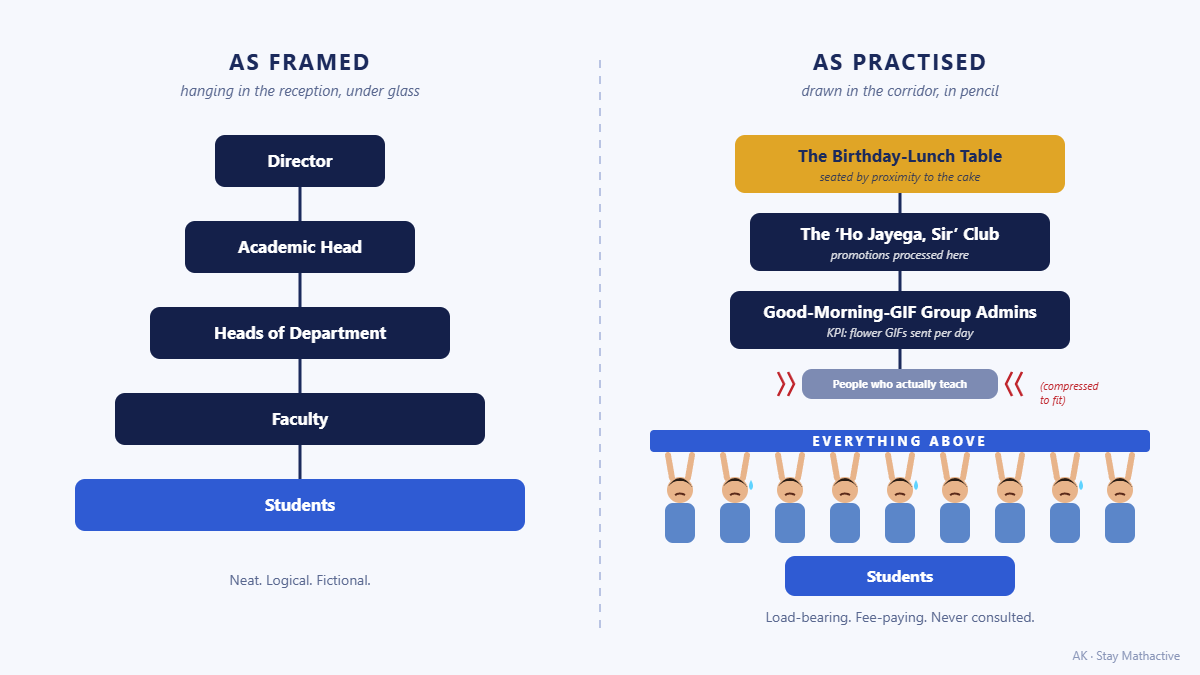
Every coaching institute has two organisation charts.
The first hangs in the reception, framed and under glass, right beside the poster of one hundred and forty-seven smiling toppers. The Director’s photograph sits at the top, then the Academic Head (if not the photograph, then at least the name), and at the bottom, in the widest box, the students: a hundred different heads on the same blazer-wearing body. It is neat. It is logical. It is fiction.
The second chart hangs nowhere. Nobody drew it, yet everybody knows it by heart. It is drawn by who sits next to whom at the Director’s birthday lunch, by who replies first to the 6:02 a.m. “Good morning, sir 🙏” on the staff WhatsApp group, and by who can say “Ho jayega, sir” with the straightest face about something that will never happen.
The Greeks had a word for the second chart. Kakistocracy, from kakistos (worst) and kratos (rule): government by the worst. The word is usually saved for politicians. But it does not need a parliament. It needs only a hierarchy, a few favourites, and a building with a big hoarding outside.
And here is the sad part. In coaching, kakistocracy does not look evil. It looks administrative. It carries a lanyard, attends every meeting, and has a very nice Excel sheet.
Everything Works, Nothing Works
A kakistocratic institute does not collapse. That would be too honest. Classes run on time. The Sunday test happens every Sunday. Results are declared, posters go up, and meetings go on until the tea goes cold.
This surface normality is exactly the problem. A collapse forces reform. A slow malfunction only asks for obedience. Nobody can point at a single disaster, so everybody points at the timetable and says, “See, everything is going fine.”
Nothing fails dramatically. Everything fails procedurally.
Who Rides the Escalator, Who Takes the Stairs
In 1969 Laurence Peter and Raymond Hull wrote a satire called The Peter Principle. Its famous line is that in a hierarchy every employee tends to rise to the level of his incompetence: people are promoted for being good at one job until they reach a job they cannot do, and there they stay.
Coaching institutes have improved on Peter. Here, you do not even need to be good at the previous job. The unwritten eligibility criteria for a Head of Department usually look like this:
- seniority on the staff WhatsApp group, measured in flower GIFs;
- the ability to agree with the Centre Head before he has finished his sentence;
- being from the same town, the same college, or the same evening walk as someone important;
- a proven record of never asking “why”.
Teaching ability is welcome too, as long as it does not cause trouble.
Meanwhile, the labels get handed out with great efficiency. The teacher who questions a shallow policy is negative. The teacher who asks for depth is impractical. The teacher who stays silent and fills every form on time is a team player. Within two appraisal cycles, the staff room learns the lesson perfectly.
In a healthy institute, competence attracts responsibility. In a kakistocratic one, it attracts suspicion.
The Durbar of Batch Allotment
If you want to see favouritism at work, do not read the policy. Watch the batch allotment.
It is conducted like a royal durbar. The bright batch, the one whose names will appear on next year’s posters, goes to the favourite. The weak batch, admitted in a hurry to meet the target, goes to the capable teacher who has no godfather. In March the results arrive, and the favourite is felicitated for the bright batch while the capable teacher is “counselled” about the weak one. Cause and effect have been politely swapped.
And every durbar has its VIPs. The cabin where the AC actually works. The chai that arrives without being ordered. The parking spot that nobody else may touch, even on a holiday. A teacher waits forty minutes outside that cabin to discuss a batch of sixty students; a parent with a large cheque walks straight in. Nobody announces the VIP culture. Everybody simply learns which doors open by knocking and which open by themselves.
Scott Adams once suggested, with a straight face, that companies promote their least competent people into management to keep them away from the real work. That is called the Dilbert principle. Coaching has a local version. Here the incompetent are not kicked upstairs to keep them out of the way. They are kicked upstairs so they can get in everybody’s way.
When the Dashboard Becomes the Classroom
Kakistocracy loves numbers, because numbers look objective and need no understanding. So the institute becomes a dashboard: lectures delivered, percentage of syllabus covered, feedback-form scores, admissions brought in per teacher.
Walk into a senior admin cabin at any hour and you will find the same scene: a man scrolling a Google Sheet. Up, down, filter, colour a cell red, scroll again. Ask him what is happening in Class 11-B and he will tell you the attendance percentage. Ask him what is happening inside the students’ heads and he will open another tab.
His vocabulary arrives every Monday by email from the central office: result orientation, student-centric delivery, zero tolerance for backlog, let us align on this. He repeats these phrases in every meeting with the confidence of a man who has never had to define them. The phrases travel downwards with great speed. They never come back up with a question attached.
The feedback form deserves a special salute. A fifteen-year-old, ten minutes before his bus, rates his teacher on “friendliness” and “interesting delivery.” The teacher who gave more homework scores lower. The teacher who told jokes and finished the chapter early scores higher. The jokes teacher gets the bright batch next year. You can guess the rest.
Economists know this trap as Goodhart’s law, best remembered in the anthropologist Marilyn Strathern’s phrasing: when a measure becomes a target, it ceases to be a good measure. Coaching institutes did not read Goodhart. They simply proved him right, every quarter.
Syllabus finished. Confusion untouched.
The Open Door That Opens Only Outwards
Every institute claims to have an open door. In practice it opens only outwards.
Offer a sensible suggestion, and I have offered a few: fewer tests and more discussion of the tests already taken, a doubt hour that actually happens, a revision plan built from students’ real mistakes. Then watch the ritual. First a polite nod. Then “we will discuss it in the review.” Then silence. Six months later, if the same idea works somewhere else, it comes down from the central office as a new initiative, and the same people present it to you in a meeting, slides and all.
The idea was rarely the problem. The problem was ego, the quiet inferiority of someone who knows that the teacher in front of him understands the subject better, and the insecurity of a chair that was given rather than earned. To accept a good suggestion from below is to admit that the upper steps of the ladder are occupied by the wrong people. So the suggestion is rejected, and the ladder is protected.
A good idea from below is not received as help. It is received as a threat.
Mathematics, the Unforgiving Witness
No subject exposes this system better than mathematics. A man can talk his way through many things, but he cannot talk his way through a definite integral on a whiteboard in front of sixty students. Mathematics shows, quite naturally, who understands and who does not. That makes it inconvenient.
So the system does not reject mathematics. It domesticates it. Proof becomes a shortcut. A good doubt becomes “Class ke baad.” Depth becomes “not in the JEE pattern.” Speed becomes intelligence. And the teacher who explains why a formula works is reported, in the weekly review, as “slow in syllabus completion.”
A Page from My Own Diary
I do not write this from a library. In June 2024, a few months after joining a large and well-known institute with great hope, I wrote a short note in my journal. I am not going to name the place; the place does not matter, because the pattern is everywhere. The note said: “There is no system. There is no thinking. There is no scope of creativity. There is no chance of improvement.”
I had been given one of their “super” batches, the badge of honour in that world, and yet the same page says I felt underpaid, underrated, and underestimated. One line in that note matters more than my complaint: the main sufferers are students.
Reading it again more than a year later, I notice what I did not write. I did not write that anybody there was evil. Nobody was. They were pleasant, busy, and very good at meetings. That is precisely the point of this article.
Why the Best Leave, or Fall Silent
Kakistocracy is very efficient at one thing: attrition.
The idealistic exhaust themselves.
The capable learn silence.
The excellent either leave, or resign emotionally and keep coming to work.
The irony is that the industry knows exactly who its real asset is. When edtech companies began hiring experienced faculty from the offline institutes in 2022, the Hindustan Times reported that institutes feared their most popular teachers would leave and the students would walk out behind them. The same institutes, on an ordinary Monday, treat those teachers as replaceable parts. They value the teacher on the hoarding and ignore the teacher in the classroom.
What remains after the attrition is not villainy. It is stable mediocrity. And the system calls this stability “success.”
The Lesson Nobody Planned to Teach
Students are not fools. They watch. They see which teacher is respected and which is merely used. They notice that the teacher who answered their doubts patiently has suddenly “left for personal reasons,” and that the one who never answered doubts is now the HOD.
Quietly, they learn the real syllabus: that loyalty beats learning, that appearance beats understanding, and that the safest answer is the one the boss wants to hear. No module covers this. Every module teaches it.
A Few Small Defences
For parents choosing an institute
- Ask who will teach, not which building. The hoarding does not take classes.
- Ask how long the teachers have stayed. An institute where good teachers leave every year is telling you something its brochure will not.
- Read the topper poster with a pinch of salt. Ask how many of those faces actually studied in that centre, in that batch, for that year.
For teachers inside the machine
- Guard the classroom. It is the one room the second org chart cannot enter. Whatever happens in the corridor, the forty minutes in front of students are yours.
- Keep a record of your own work. Notes, problem sets, students’ progress. Your value should not live only in someone else’s appraisal form.
- Find colleagues outside the building. A community of teachers who care about depth is the best cure for staff-room loneliness.
For those who run institutes
- Look at your last three promotions and honestly write down why each person was chosen.
- Sit in a class, unannounced, once a month. Not to inspect. To remember what the business is.
- Talk to the last good teacher who left. The exit interview you skipped is the most useful report you never read.
The Institute Survives
Kakistocracy does not destroy an institute. The building stands, the hoarding shines, and the batches fill up every April. What it destroys is quieter: the trust of teachers, the curiosity of students, and the idea that learning is a transformation and not a transaction.
When those who cannot teach begin to manage those who can, the institute survives. Only the thinking quietly resigns.
Stay Mathactive.
— Ashutosh Kumar
Sources
- Kakistocracy. Wikipedia.
- Peter, L. J., & Hull, R. (1969). The Peter Principle: Why Things Always Go Wrong. William Morrow. See also Peter principle (with the Dilbert principle), Wikipedia.
- Strathern, M. (1997). ‘Improving ratings’: audit in the British University system. European Review, 5(3), 305–321. See also Goodhart’s law, Wikipedia.
- Sengupta, D., & Devroy, S. (2022, June 13). Teachers win big as edtech firms eye slice of offline coaching. Hindustan Times.
Get Mathactive Sunday in your inbox
A new article every Sunday morning on mathematics, learning and teaching, for parents and teachers. Free, and you can unsubscribe at any time.
Prefer videos, or a short post every day?